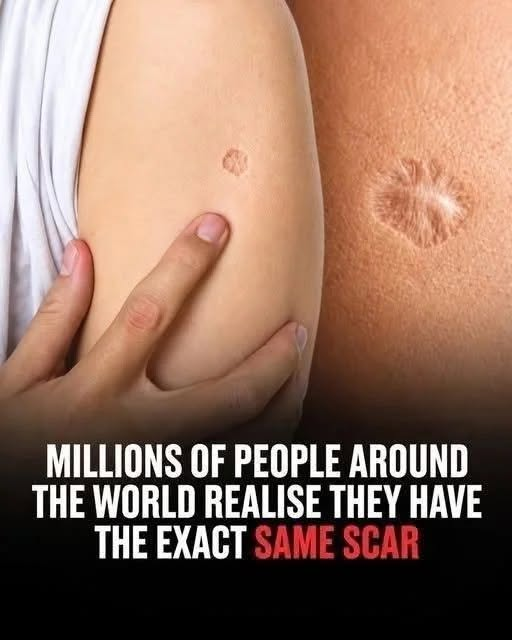
Unlike many modern vaccines that are administered using a single injection, the traditional smallpox vaccine was commonly delivered using a special technique.
One widely used method involved a small instrument called a bifurcated needle.
This instrument had two tiny prongs designed to hold a small amount of vaccine.
A healthcare worker used the needle to make several quick, shallow punctures in the skin, usually on the upper arm.
These punctures allowed the vaccine to enter the superficial layers of the skin.
The vaccine contained vaccinia virus, a virus related to smallpox that could stimulate the immune system to develop protection against the disease.
After vaccination, a recognizable local reaction often developed.
The area could become:
Red and slightly swollen.
Raised and irritated.
A small blister or lesion.
A larger, sometimes fluid-filled lesion.
A scab that eventually dried and separated.
After the scab fell away, some people were left with a permanent circular scar.
The appearance of the scar depended on several factors, including the intensity of the skin reaction, the individual’s healing process, and the vaccination technique.
This is why so many people vaccinated during certain periods have similar-looking marks.
The scar is essentially a reminder of the body’s local reaction to the vaccine.
4. Why Was the Vaccine Usually Given on the Upper Arm?
There was a practical reason for choosing the upper arm.
This area provided a convenient and accessible location for administering the vaccine.
It was also relatively easy for healthcare professionals to examine the vaccination site during follow-up.
Because the vaccine produced a noticeable skin reaction, the location needed to be easy to monitor.
The upper arm was therefore commonly selected in many vaccination programs.
Over time, the practice became so widespread that the small circular scar became a recognizable feature among people who received the traditional smallpox vaccine.
However, vaccination practices differed between countries and historical periods.
Not everyone received the vaccine in precisely the same location, and not everyone developed a visible scar.
5. The Other Possible Explanation: The BCG Vaccine
There is another important reason why someone might have a small circular scar on their upper arm.
It is the BCG vaccine.
BCG stands for Bacillus Calmette-Guérin.
This vaccine has been used in many countries to help protect against tuberculosis, particularly severe forms of tuberculosis in children.
Tuberculosis is an infectious disease caused by bacteria called Mycobacterium tuberculosis.
It most commonly affects the lungs, although it can also affect other parts of the body.
The BCG vaccine has played an important role in protecting children against serious forms of tuberculosis, including tuberculous meningitis and disseminated tuberculosis.
In many countries, the BCG vaccine is administered during infancy.
It is usually given just under the skin, often in the upper arm.
Unlike many routine injections, BCG vaccination commonly produces a local skin reaction.
The area may initially appear slightly red or raised. Over time, a small lesion can develop, sometimes forming a scab before healing.
A small scar may remain afterward.
This means that someone who notices a circular mark on their upper arm may have received BCG vaccination rather than smallpox vaccination.
The two scars can sometimes look similar, particularly many years after vaccination.
6. How Can You Tell Whether It Is a Smallpox or BCG Scar?
This is where things become interesting.
Although both vaccines can leave a visible mark, there are some historical and physical clues that may help explain its origin.
The age of the person
People born during periods when smallpox vaccination was routinely administered may have received the smallpox vaccine.
People born in countries where BCG vaccination was routinely given during infancy may have a BCG scar.
The vaccination history
Family records, childhood medical documents, and vaccination cards may provide useful information.
For example, if someone received BCG vaccination as a newborn, a small scar may have developed during the following weeks or months.
The appearance
Traditional smallpox vaccination scars are often described as round, sometimes with a distinctive textured or depressed center.
BCG scars can also be small and round, although their appearance varies considerably.
Unfortunately, appearance alone cannot reliably identify which vaccine caused a particular scar.
The most accurate explanation usually comes from vaccination records and the person’s medical history.