Perhaps the most remarkable part of this story is what happened after vaccination campaigns expanded around the world.
For many generations, smallpox seemed almost impossible to defeat.
Outbreaks occurred in different regions, and the disease continued to threaten populations.
However, international cooperation and systematic vaccination gradually changed the situation.
The World Health Organization launched an intensified global smallpox eradication program in 1967.
Healthcare workers used vaccination campaigns, disease surveillance, and rapid responses to outbreaks.
One important strategy was known as surveillance and containment.
Instead of simply vaccinating large populations without considering local outbreaks, public health teams identified infected individuals, traced their contacts, and vaccinated people in surrounding communities.
This approach helped interrupt transmission.
The last known naturally occurring case of variola major was recorded in Bangladesh in 1975.
The last naturally occurring case of smallpox overall was recorded in Somalia in 1977.
Following extensive scientific assessment, the World Health Organization officially declared smallpox eradicated in 1980.
This achievement remains one of the greatest successes in the history of medicine.
It was the first human infectious disease to be eradicated worldwide through coordinated public health efforts.
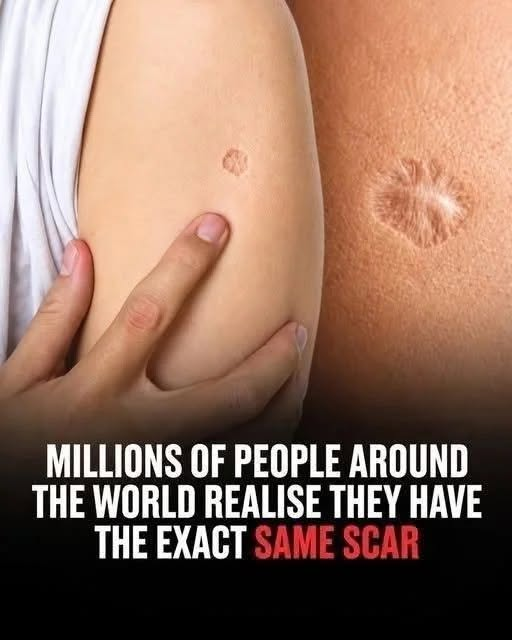
The little scar left by vaccination therefore represents more than an individual medical experience. For many people, it is connected to a global achievement that changed public health forever.
8. Why Don’t Younger Generations Have the Same Scar?
If you look at the arms of younger people today, you may notice that many do not have the familiar smallpox vaccination mark.
There is a simple explanation.
Routine smallpox vaccination stopped in most countries after the disease was eradicated.
Because smallpox no longer circulates naturally, routine vaccination is not generally recommended for the public.
As a result, people born after the end of routine smallpox vaccination programs generally do not have the traditional smallpox scar.
However, some younger people may still have a similar-looking mark because they received the BCG vaccine.
BCG vaccination continues to be used in countries where tuberculosis remains an important public health concern.
Therefore, the presence or absence of a circular upper-arm scar can sometimes reflect the vaccination practices that were common during a particular generation.
9. Does the Scar Mean the Vaccine Is Still Working?
A common question is whether the presence of a vaccination scar means someone is still protected against the disease.
The answer depends on which vaccine caused the scar.
For the smallpox vaccine, the scar indicates that a local skin reaction occurred after vaccination.
However, the scar itself is not a reliable measurement of an individual’s current immunity.
Immune protection involves complex processes, including immune memory and the activity of specialized cells and antibodies.
A visible scar cannot tell you exactly how strong someone’s immunity is today.
The same principle applies to BCG vaccination.
The presence or absence of a BCG scar does not reliably establish whether a person is protected against tuberculosis.
Some people develop noticeable scars after BCG vaccination, while others develop very small marks or no visible scar at all.
A healthcare professional can provide appropriate guidance if someone has questions about their vaccination history.
10. Should You Be Worried About an Old Circular Scar?
In most cases, a stable scar that has been present for many years does not require special treatment.
Old vaccination scars are generally harmless.
However, it is important not to assume that every circular mark is a vaccine scar.
Other possibilities include:
Childhood injuries.
Healed skin infections.
Previous burns.
Insect bites.
Certain inflammatory skin conditions.
Other forms of skin trauma.
If a mark is new, changing, painful, bleeding, or becoming larger, it should be examined by a healthcare professional.
A dermatologist can assess unusual skin changes and determine whether further investigation is necessary.
It is also important to avoid scratching, cutting, or applying harsh chemicals to old scars in an attempt to remove them.
Most old vaccination scars do not need treatment unless someone wishes to discuss cosmetic options.
11. Why This Tiny Scar Is Such an Important Piece of History
It is easy to look at a small mark on someone’s arm and think nothing of it.
But for millions of people, that mark is connected to a period when infectious diseases represented a major threat to everyday life.
It reminds us of a time when vaccination campaigns were essential to protecting entire communities.
Healthcare workers traveled to villages, towns, and cities to vaccinate people and prevent outbreaks.
Scientists developed improved vaccination techniques, while governments and international organizations coordinated efforts to reach populations around the world.
The eventual eradication of smallpox demonstrated what can happen when scientific research, public health planning, and international cooperation work together.
Today, many people carry a tiny reminder of that extraordinary achievement without even knowing its history.
Final Thoughts: The Small Scar With a Remarkable Story
That familiar circular scar on the upper arm may look like an ordinary skin mark, but it can have a fascinating history.
For many people, it is associated with the traditional smallpox vaccine, which helped protect generations against a deadly disease that was eventually eradicated worldwide.
For others, a similar mark may be the result of BCG vaccination against tuberculosis.
Although the two scars can look alike, their origins are different.
The next time you notice this familiar mark on someone’s arm, remember that it may represent an important chapter in medical history.
Sometimes, the smallest marks carry the biggest stories.
Tighten Repeated Explanations About Vaccination Scars