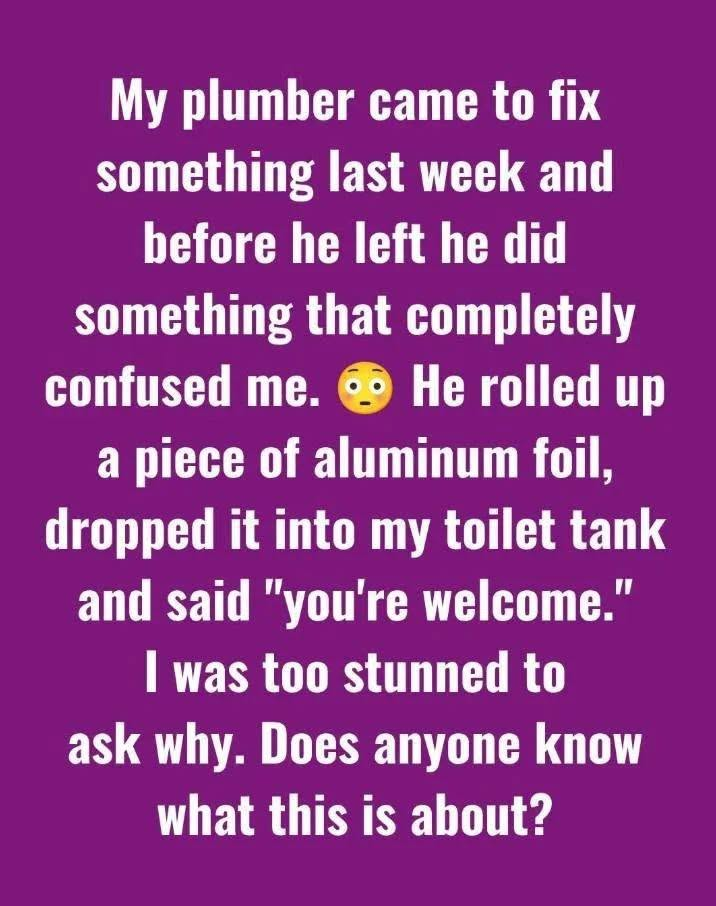
One of the most frequently repeated explanations is that aluminum foil helps prevent rust inside the toilet tank.
To understand this claim, it helps to know what rust actually is.
Rust develops when iron-containing materials react with oxygen and moisture over time.
Depending on the water supply and the materials used in the plumbing system, rust-colored stains may appear inside toilet tanks or toilet bowls.
Aluminum is a metal with different corrosion properties from iron. It naturally develops a thin protective oxide layer when exposed to air.
However, simply placing a loose piece of aluminum foil inside a toilet tank does not create a reliable rust-prevention system.
Specialized corrosion-control methods exist in certain industrial and plumbing applications, but they depend on specific conditions and carefully designed systems.
A random piece of kitchen foil floating or sitting at the bottom of a toilet tank is not an established substitute.
If you repeatedly notice reddish-brown stains, the better approach is to identify the source of the iron or corrosion rather than relying on aluminum foil.
3. Can Aluminum Foil Remove Limescale and Hard Water Deposits?
Another popular explanation suggests that aluminum foil attracts minerals responsible for limescale.
Hard water contains dissolved minerals, particularly calcium and magnesium.
When water evaporates or changes chemically, these minerals can accumulate on surfaces, leaving white or chalky deposits.
Over time, mineral buildup may become noticeable around toilet bowls, faucets, showerheads, and other bathroom fixtures.
Unfortunately, aluminum foil does not function as a water softener.
It does not reliably remove calcium and magnesium from water simply by sitting inside a toilet tank.
If your bathroom has hard-water deposits, more appropriate solutions include:
Cleaning suitable surfaces with diluted white vinegar.
Using a toilet descaling product appropriate for the fixture.
Cleaning mineral deposits regularly.
Maintaining bathroom fixtures properly.
Considering a suitable water-softening system if hard water is a persistent household problem.
Always follow product instructions and never mix cleaning chemicals, especially bleach with acidic products.
4. Does the Aluminum Foil Trick Keep the Toilet Bowl Cleaner?
This is another claim that sounds appealing.
Imagine never having to scrub stubborn toilet stains again because a small piece of aluminum foil is supposedly doing the work automatically.
Unfortunately, there is no established scientific mechanism showing that ordinary aluminum foil inside a toilet tank disinfects the toilet bowl or removes dirt.
Every time you flush, water travels from the tank into the bowl.
The water does not become a cleaning solution simply because aluminum foil has been placed inside the reservoir.
Toilet cleaning still requires appropriate cleaning products, regular maintenance, and physical removal of deposits when necessary.
A good cleaning routine can help prevent stains and unpleasant odors without introducing unnecessary objects into the plumbing system.
5. Could Aluminum Foil Actually Damage Your Toilet?
This is perhaps the most important part of the story.
A toilet tank is not an empty storage container. It contains several mechanical components that must operate freely.
These include:
The fill valve: Controls the water entering the tank after each flush.
The float: Helps regulate the amount of water stored inside the tank.
The flush valve: Releases water into the toilet bowl.
The flapper: Creates a seal that prevents water from continuously escaping into the bowl.
The overflow tube: Helps prevent the tank from filling beyond its intended level.
A loose object inside the tank may move around as water enters and leaves.
Depending on its position and the toilet design, it could potentially interfere with a moving component or prevent a sealing mechanism from operating correctly.
This could result in a toilet that continues running after flushing.
A constantly running toilet can waste considerable water over time.
That is why introducing unnecessary objects into a working toilet tank is generally not recommended.
The safest option is to keep the tank free of foreign objects unless the manufacturer specifically recommends an approved accessory.