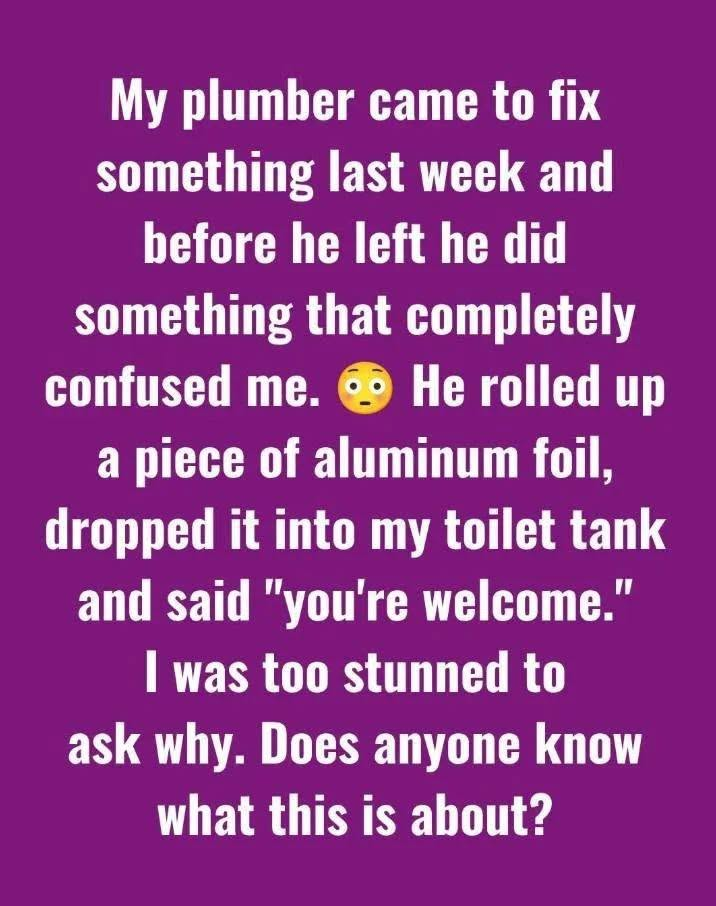
Some people believe that aluminum foil can reduce water consumption because it takes up space inside the toilet tank.
The basic idea is that an object occupying part of the tank leaves less room for water.
Although water displacement is a real physical principle, a small ball of aluminum foil is not a reliable water-saving solution.
Its volume is generally too small to make a meaningful difference.
More importantly, toilets are designed to use an appropriate quantity of water to remove waste effectively.
Reducing the available water without considering the toilet’s design can result in incomplete flushing.
You may end up flushing twice, which can eliminate any theoretical savings.
If your goal is to reduce your water bill, consider checking the fill valve, repairing leaks, or installing a suitable water-efficient toilet.
These methods address water consumption more effectively.
7. What Should You Do If Your Toilet Tank Has Rust or Dirt?
Instead of experimenting with questionable household tricks, it is better to maintain the tank correctly.
A simple inspection can help you identify common problems.
Start by removing the toilet tank lid carefully and placing it somewhere safe.
Look for visible rust-colored deposits, mineral buildup, damaged components, or unusual debris.
If you notice a problem, consider the following steps.
Step 1: Turn off the water supply.
Locate the shutoff valve near the toilet and turn it off before performing maintenance that requires draining the tank.
Step 2: Flush the toilet.
This removes most of the water from the tank.
Step 3: Inspect the components.
Check the flapper, fill valve, float, and other visible parts for damage or deterioration.
Step 4: Clean appropriately.
Use a cleaning method compatible with the tank materials and manufacturer recommendations.
Avoid aggressive chemicals that could damage rubber seals and plastic components.
Step 5: Refill and test.
Turn the water supply back on and check that the tank fills correctly and stops running after the appropriate water level is reached.
If you discover a damaged valve, persistent leak, or significant corrosion, consider contacting a qualified plumber.
8. A Simple Trick to Check Whether Your Toilet Is Leaking
Many homeowners do not realize that their toilets can waste water even when nobody is using them.
A leaking flapper is one common reason.
Fortunately, there is a simple way to check for a possible leak.
You can use a few drops of food coloring.
- Remove the toilet tank lid.
- Add several drops of food coloring to the tank water.
- Do not flush the toilet.
- Wait approximately 10 to 15 minutes.
- Look inside the toilet bowl.
If colored water appears in the bowl, water may be escaping from the tank through the flapper or another part of the flush valve.
This simple test can help identify a possible problem without removing the toilet or calling someone immediately.
If a leak is confirmed, inspect the sealing mechanism or ask a plumber to repair it.
Fixing a leaking toilet is a much more effective way to save water than placing aluminum foil inside the tank.
9. Why Do Strange Household Tricks Become So Popular?
The aluminum foil toilet trick is an interesting example of how ordinary household objects can become internet sensations.
People naturally enjoy discovering inexpensive ways to solve everyday problems.
A trick involving something as common as aluminum foil is especially attractive because almost everyone already has it in the kitchen.
Social media also makes these ideas easy to demonstrate.
A short video showing someone placing foil inside a toilet tank can generate curiosity almost immediately.
But there is a problem with many viral household hacks.
A video can show that someone performed a particular action, but it cannot necessarily prove that the action produces the promised result.
For example, a toilet may continue flushing normally after someone places foil inside the tank.
That does not prove that the foil prevents rust, removes limescale, saves water, or prevents leaks.
Those claims would require proper testing.
Before copying an unusual household trick, it is worth asking three questions:
- Is there a reasonable explanation for how it works?
- Is there reliable evidence supporting the claimed benefit?
- Could the method damage something in the home?
These questions can help prevent unnecessary repairs and expenses.
10. What Is the Best Way to Keep Your Toilet Working Properly?
Related Posts: