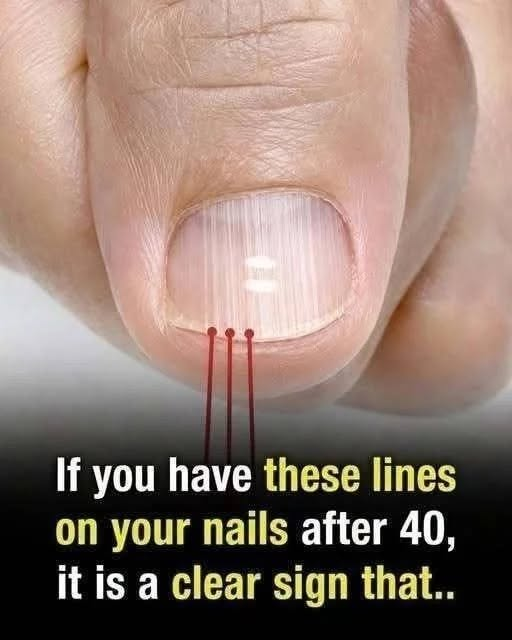
Your body requires several nutrients to maintain healthy nails.
When nutritional intake is inadequate, changes in nail growth and appearance may sometimes develop.
Iron deficiency is one example.
Some people with iron deficiency develop brittle nails, and in more severe cases, the nails may become unusually thin or spoon-shaped.
Other possible nutritional concerns include inadequate protein intake and certain vitamin deficiencies.
However, an important distinction must be made: ordinary vertical ridges are not a reliable way to diagnose a nutritional deficiency.
You cannot determine whether someone has low iron, vitamin B12 deficiency, or another nutritional problem simply by examining a few lines on their fingernails.
If nail changes occur alongside symptoms such as persistent fatigue, weakness, unusual hair loss, or dizziness, a healthcare professional may recommend appropriate blood tests.
Eating a balanced diet that includes the following foods can support normal nail growth:
Eggs.
Fish.
Beans and lentils.
Nuts and seeds.
Leafy green vegetables.
Whole grains.
Dairy products or suitable alternatives.
Lean meat.
Supplements should not be taken automatically to treat nail ridges. The appropriate approach depends on whether a deficiency is actually present.
4. Horizontal Lines Across the Nails May Have a Different Meaning
Not all nail lines are the same.
While vertical ridges run from the cuticle toward the fingertip, horizontal grooves run across the width of the nail.
These are sometimes called Beau’s lines.
They develop when normal nail growth is temporarily interrupted.
Possible causes include:
A significant illness.
High fever.
Severe physical stress.
Certain infections.
Major surgery.
Some medical treatments.
Significant nutritional stress.
Because fingernails grow relatively slowly, a horizontal groove may become visible weeks after the event that affected nail growth.
The position of the line can sometimes provide an approximate indication of when the interruption occurred.
If several nails develop deep horizontal grooves without an obvious explanation, medical evaluation is advisable.
These lines do not automatically mean that someone has a serious illness, but they can occasionally provide useful information about previous health events.
5. Dark Vertical Lines Should Never Be Automatically Dismissed
One nail change that deserves particular attention is a dark vertical stripe.
This condition is called longitudinal melanonychia.
It appears as a brown or black band running lengthwise along the nail.
There are several possible explanations.
Some dark bands are caused by increased pigment production and are harmless.
Possible causes include:
Normal pigmentation.
Genetic factors.
Previous nail trauma.
Certain medications.
Benign changes in pigment-producing cells.
However, a new or changing dark band on a single nail can occasionally be a sign of subungual melanoma, a rare type of skin cancer that develops beneath the nail.
Warning signs include:
A new dark stripe affecting one nail.
A band that becomes wider over time.
Irregular or uneven coloring.
Pigment spreading onto the surrounding skin.
Changes in the nail itself.
Bleeding or unexplained nail damage.
Not every dark stripe is cancer, but a suspicious new or changing band should be examined promptly by a dermatologist.
Do not attempt to cover it permanently with nail polish without first understanding its cause.
6. White Lines or Spots on Fingernails: What Do They Mean?