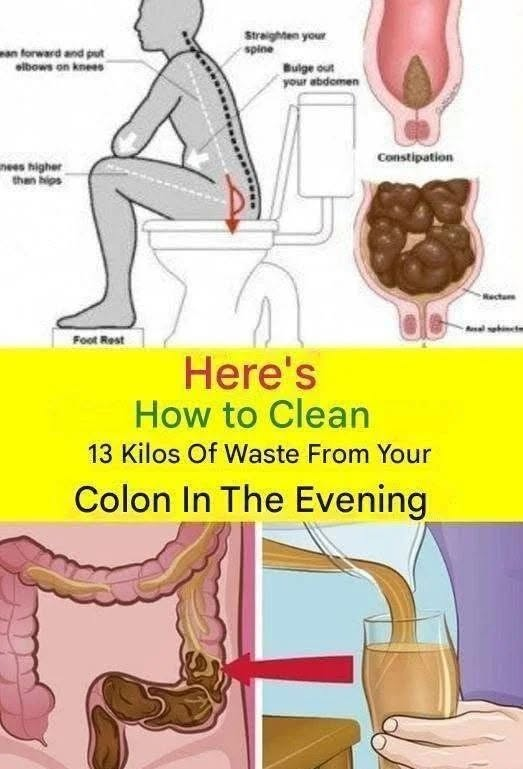
Have you ever come across a claim that your colon contains up to 13 kilograms of accumulated waste and that you can eliminate it in a single evening? This surprising statement has circulated widely on social media, leaving many people wondering whether their digestive system is secretly holding onto pounds of old waste.
The idea sounds alarming, especially when accompanied by pictures showing a supposedly clogged colon and a glass of liquid advertised as a quick cleansing solution. But how much truth is there behind these claims?
Your digestive system plays an essential role in maintaining your overall health. It processes food, absorbs nutrients and water, and eliminates the waste your body no longer needs. When digestion slows down or constipation develops, you may experience bloating, abdominal discomfort, hard stools, and difficulty going to the bathroom.
The good news is that there are simple, practical ways to support healthy bowel movements without resorting to extreme cleansing methods.
Before trying any popular colon-cleaning trick, it is important to understand what actually happens inside your body.
1. Does Your Colon Really Store 13 Kilograms of Waste?
One of the most common claims about colon cleansing is that the average person carries between 5 and 13 kilograms of old waste inside their intestines.
Although this number sounds frightening, there is no reliable scientific evidence supporting the idea that healthy people routinely accumulate such enormous quantities of hardened waste in their colons.
Your colon is not designed to function as a storage container for years of undigested food.
Instead, it is an active part of your digestive system. After food passes through your stomach and small intestine, the remaining material enters the large intestine. Your colon absorbs water and electrolytes, while beneficial intestinal bacteria help break down certain substances.
The remaining material gradually becomes stool and eventually leaves the body through a bowel movement.
Sometimes constipation causes stool to remain in the colon longer than usual. This can make bowel movements uncomfortable and may lead to bloating, abdominal pain, and a feeling of incomplete evacuation.
However, ordinary constipation should not be confused with the accumulation of kilograms of mysterious toxic waste.
A healthy digestive system already has its own natural waste-removal mechanism.